Couples Counseling
Couples counseling for intimacy issues helps partners rebuild trust, communication, and closeness. Learn the signs, causes, and how therapy works.

Couples counseling for intimacy issues helps partners rebuild trust, communication, and closeness. Learn the signs, causes, and how therapy works.

Couples counseling for intimacy issues is a type of therapy that helps partners understand why they feel distant and learn how to reconnect. It is not just about sex. It is about feeling safe, wanted, and understood by the person you love. Many couples wait years before asking for help. They think the problem will fix itself. It usually does not. The good news is that talking to a trained counselor can change how you and your partner see each other and how you touch, talk, and trust again.

Most people hear "intimacy" and think of physical closeness. That is only one part. Intimacy is the whole feeling of being close to your partner. It shows up in several ways .
Emotional intimacy is sharing your real thoughts and feelings. You tell your partner when you are scared, sad, or excited. You feel heard.
Physical intimacy is not only sex. It is holding hands, hugging, kissing, and sitting close on the couch. It is the small touch that says "I am here."
Intellectual intimacy is talking about ideas and dreams. You respect each other's minds. You enjoy the same conversations.
Experiential intimacy is doing things together. You build memories. You laugh at the same jokes. You share hobbies.
Spiritual intimacy is connecting through shared values or beliefs. It can be religious, or it can simply be a shared sense of purpose.
When one of these areas breaks down, the others often follow. A couple who stops talking about their feelings may also stop touching. A couple who stops touching may feel awkward talking. This is why counseling looks at the whole relationship, not just the bedroom.
Read Also: How To Stop Repeating The Same Argument In A Relationship
Every couple has hard weeks. But some patterns do not go away on their own. Here are signs that it may be time to talk to someone .
You live together. You split chores. You talk about bills and kids. But you do not talk about you. You cannot remember the last time you had a real conversation about something that mattered. You feel like you are managing a household together, not sharing a life.
You cannot remember the last time you hugged for no reason. Kisses are quick pecks. Sex has become rare, or it has stopped completely. When you do touch, it feels forced or tense.
One of you brings up the distance. The other changes the subject. Or you both avoid it because every conversation turns into a fight. You have learned that it is easier to say nothing than to open a wound.
You are angry about something that happened months or years ago. You never worked through it. Now it sits between you like a wall. You cannot be close to someone you are still mad at.
One partner is always the one asking for closeness. The other is always pulling away. The asking partner feels rejected. The pulling away partner feels pressured. This cycle is painful for both people.
People often blame themselves or their partner when intimacy fades. That blame does not help. Most intimacy problems come from normal life events and normal human fears.
Stress is a major cause. When you are worried about money, work, or family, your body and mind focus on survival. Closeness feels like one more thing you have to do. It stops being a source of comfort.
Unresolved conflict builds walls. If you had a fight and never repaired it, your body remembers. You may not feel safe being vulnerable with someone you are still guarding against.
Past hurt can also play a role. If one partner had an affair, or if one partner grew up in a home where affection was rare, the idea of being close can feel dangerous. The person may want closeness but also fear it.
Different desires are normal. One partner may want sex more often. The other may need more emotional connection first. When these differences are not talked about, they turn into hurt feelings and couples counseling for intimacy issues.
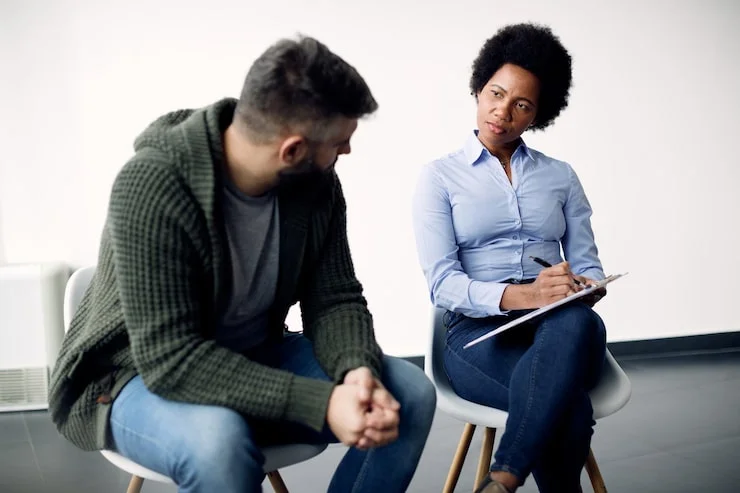
A couples counselor does not pick sides. The counselor is not there to decide who is right or wrong. The counselor is there to help both partners understand the pattern they are stuck in.
In the beginning, the counselor will ask about your relationship. How did you meet? What was good in the early days? When did things start to change? Each partner gets time to speak. The counselor listens for the cycle that keeps repeating .
Most couples have a repeating loop. One partner reaches out. The other pulls back. The reaching partner feels rejected and reaches harder. The pulling partner feels smothered and pulls further. The counselor helps you see this loop. Once you see it, you can stop blaming each other and start working on the loop itself.
A counselor teaches you how to speak so your partner can hear you. Instead of saying "You never touch me," you learn to say "I miss feeling close to you, and I do not know how to ask for it." Instead of saying "You are always pressuring me," you learn to say "I need some space first, and then I can be close." These small changes in language make a big difference.
For intimacy to return, both partners need to feel safe. Safe means you can say what you need without being attacked. Safe means your partner will not laugh at you or turn away. The counselor helps you build that safety step by step. Sometimes this starts with small things, like a daily check-in or a rule that you do not walk away during hard talks.
Many counselors use specific methods that have been studied and tested with couples. Two of the most common are Emotionally Focused Therapy and the Gottman Method.
Emotionally Focused Therapy (EFT) focuses on the emotional bond between partners. The idea is that humans are wired to need secure connection. When that connection feels threatened, we either fight for it or shut down. EFT helps partners see the fear under the anger. One partner is not cold; they are scared of being hurt. The other is not clingy; they are scared of being left. When partners can show that fear to each other, the cycle softens. Research shows EFT can improve intimacy, including after painful events like betrayal .
The Gottman Method is based on decades of research on what makes relationships last. One key finding is that fondness and admiration are strongly linked to sexual satisfaction. Couples who feel appreciated by their partner report more passion and more sex . The Gottman approach helps couples build small moments of connection every day. It also teaches them how to repair after fights so that resentment does not build up. A counselor using this method may give you exercises to do at home, like sharing a genuine compliment each day or asking open-ended questions about your partner's inner world.
You May Also Like: How Often Does Couples Therapy End In Divorce
Counseling is not a magic fix. It will not make every problem disappear. It will not force you to stay in a relationship that is unhealthy. And it will not make you want sex if your body and mind are saying no.
Counseling is a place to be honest. If one partner has decided the relationship is over, the counselor can help both people talk about that clearly. If there has been abuse, the counselor will put safety first. Counseling works best when both partners are willing to show up and try, even when it feels awkward.
The first step is the hardest. You have to say out loud that something is wrong. You may feel embarrassed. You may worry that your partner will get defensive. These feelings are normal.
Start by picking a quiet time. Do not bring it up in the middle of a fight or when you are both tired. Say something simple: "I love you, and I miss feeling close to you. I think talking to someone could help us." Use "I" statements. Do not blame.
When you look for a counselor, find someone who lists couples work and intimacy as a focus. Many counselors offer a free phone consultation. Use that call to ask how they work and whether they have experience with the issues you are facing. You can also ask if they use EFT or the Gottman Method.
You do not have to be in crisis to start counseling. Some couples go when things are "fine" but not great. They want to feel close again before the distance becomes a canyon. That is a brave choice. Intimacy is not a luxury. It is what makes a relationship feel like a relationship and not just a shared address.
It depends on the couple. Some couples feel a shift in a few sessions. Others need months to work through years of hurt. A counselor can give you a better sense after the first few meetings.
You can still go alone. A counselor can help you understand your own needs and how you respond to the distance. Sometimes one partner starting the work changes the dynamic at home.
No. Many couples have gone years without physical intimacy and still found their way back. The key is being willing to talk about the hurt and the fear, not just the act itself.
No. No counselor will tell you what to do with your body. The counselor helps you understand what is blocking closeness. You and your partner decide what you want to do with that understanding.
Sometimes. A sex therapist focuses specifically on sexual function and desire. A couples counselor focuses on the relationship as a whole. Many issues overlap. You can ask a counselor during a consultation which approach fits your situation best.